May suits a trip built around city walks and flexible outdoor days, but it is not a shortcut to Hokkaido’s summer scenery. Choose whether your priority is a particular flower, an easy city break or a longer rural route before booking. The most useful distinction is between fixed holiday dates, changeable flowering and the conditions at the place you actually plan to visit.
- Compare early-May holiday dates with later dates using actual availability.
- Pack an extra layer for mornings, evenings and exposed stops.
- Pick one spring outing; do not turn a flower photograph into a guaranteed itinerary.
1. May temperatures: five places, not one forecast
These Japan Meteorological Agency 1991–2020 normals are monthly mean / mean daily maximum / mean daily minimum, in °C. They are not the month’s absolute extremes or a forecast for your travel week. A warm afternoon does not tell you how a morning departure or evening viewpoint will feel.
Compare the observation point nearest each overnight base. Asahikawa’s average daily minimum is lower than Sapporo’s; Abashiri is cooler on these monthly measures. Kutchan is a town station, not a Niseko mountaintop. Do not use any of these city values to decide whether a mountain trail is safe.
- Sapporo: 13.0 / 17.9 / 9.0 °C
- Asahikawa: 12.3 / 18.8 / 6.1 °C
- Kutchan: 11.2 / 16.9 / 6.0 °C
- Abashiri: 9.8 / 14.6 / 5.8 °C
- Hakodate: 12.3 / 17.0 / 8.0 °C
2. What to wear for city walks and outdoor stops
Build a city outfit from a light long-sleeved layer, removable knitwear or fleece, and a wind-resistant outer layer that can handle rain. Comfortable walking shoes should cope with wet paving. Keep the warm layer accessible in your day bag rather than buried in a suitcase; sunny lunch weather can tempt you to leave it at the hotel.
For children, pack spare socks and a change that does not depend on the hotel laundry finishing before the next outing. For coast, boat or mountain activities, ask the operator about the exact clothing and footwear required. A city jacket is not a substitute for activity-specific equipment. Use the destination forecast and shorten an outing if wind or wet clothes make it uncomfortable.
3. Golden Week: compare the whole booking, not just a room
If your early-May dates overlap Japan’s Golden Week holiday period, check the public-holiday calendar for your travel year. The days off and the trip you can fit around them should be checked before comparing quotations. This guide does not promise that later May is cheaper or quieter: compare the actual flights, rooms, seats and vehicle availability for both date sets.
Build two quotes for the same travellers and number of nights: your preferred holiday dates, and a later option if your leave allows it. Include baggage, hotel meals, local transport, activity admission and cancellation terms. A cheaper room may not save money if the only available flights or car category cost more.
Before paying, check the essential connections and room occupancy for the whole party. Record which booking has the first cancellation deadline and which costs remain unquoted. Do not reserve several non-refundable alternatives while waiting to decide.
Compare complete trip budgets · Train tickets and seat booking
4. Flowers: choose a target, then verify the visit
Cherry blossoms, rapeseed and summer lavender are different trips, not interchangeable labels for a May flower tour. A photograph taken in May establishes only what was photographed then. It does not establish this year’s peak, the same field location, an event date or permission to enter farmland.
For one essential flower stop, record the named park or viewing site, current-year flowering reports, permitted visitor access, operating dates, transport and an alternative nearby. Recheck close to departure. Do not enter cultivated fields or stop a car on an unsuitable roadside to reproduce a photograph.
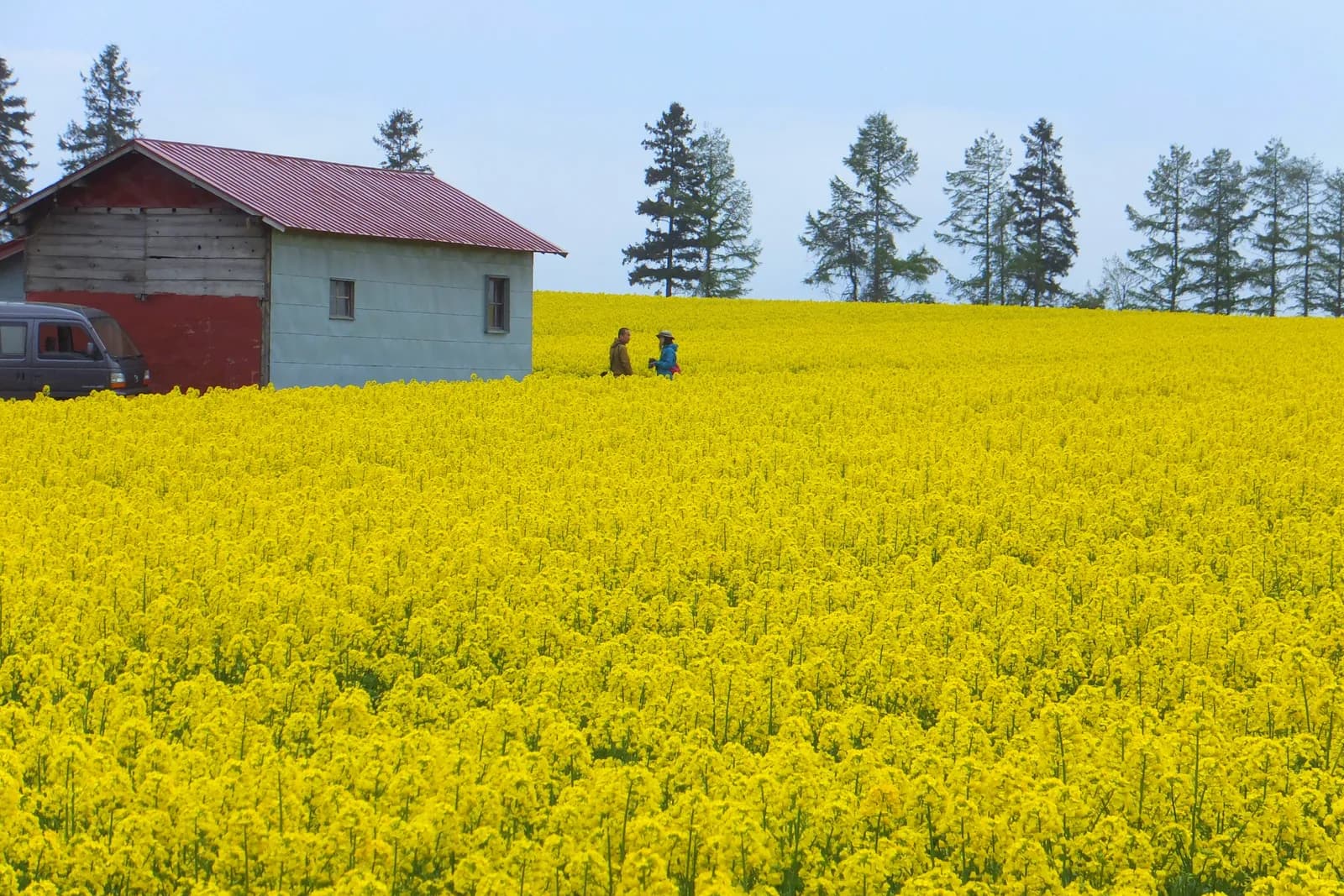
The cover is a Takikawa rapeseed-field photograph from May 2014. It is a seasonal illustration, not a confirmed festival or route for your travel dates. If you are considering Furano and Biei, use the regional guide to choose actual stops rather than assuming summer flower-field pictures describe May.
5. Three nights in Sapporo: keep one day movable
For a four-day, three-night example, keep all nights in Sapporo. Day 1 is arrival, luggage and a local meal. Day 2 is Otaru if the weather suits walking. Day 3 is either a confirmed spring outing with workable transport, or a Sapporo day. Day 4 stays near your base until luggage collection and the airport journey. This is an editorial time-allocation example, not a timetable.
Swap days 2 and 3 when conditions and reservations allow. If the flower stop needs a long journey, treat it as the main outing that day instead of adding it after Otaru. Without a confirmed return connection, choose the city alternative. Keep the final day free of a distant seasonal stop.
For the indoor version, choose a venue you actually want to visit and confirm its closure day, admission and booking requirements. A shopping or meal break can shorten outdoor time; it does not make an outdoor park weatherproof.
The shorter Sapporo–Otaru route · Sapporo indoor alternatives · Airport transfer planning
6. More nights: add a base only when it adds a full day
With five nights, one planning option is three in Sapporo and two in Asahikawa, leaving a transfer day and a full day for a confirmed local outing before the final journey. Check the actual arrival and departure airports first. An early flight from New Chitose may mean moving the final night back toward the airport instead; do not assume the last morning is sightseeing time.
Compare that split with staying in Sapporo for all five nights. The split only earns its extra packing and travel if it gives useful time at the destination. For rural driving, verify the named road sections and destination access for May; an open town road does not prove a mountain route is open or snow-free. Choose public-transport-accessible stops if you are not prepared for the expected driving conditions.
Keep a compact note: date / base / one essential outing / outbound and return transport / booking deadline / bad-weather option / next morning’s departure. If a stop cannot fit both journeys and the activity, remove it instead of borrowing time from the airport buffer.
Choose an Asahikawa base · Public transport and rental-car choices
7. Sources and photograph
Temperature source: Japan Meteorological Agency 1991–2020 normals, retrieved and checked against temperature-detail tables on 18 October 2026. The values below are the May rows of that saved dataset. No future-year flowering date, event schedule, road opening or fare is confirmed here.
Photograph: t-konno, Takikawa rapeseed fields, May 2014, CC BY-SA 3.0 via Wikimedia Commons. The existing image is resized and converted to WebP. The holiday-calendar link is for checking your travel year, not a claim that a specific future-year holiday schedule was verified for this article.
JMA — Sapporo · JMA — Asahikawa · JMA — Kutchan · JMA — Abashiri · JMA — Hakodate · t-konno / Wikimedia Commons · CC BY-SA 3.0 · Japan public-holiday calendar (Japanese)

Northern Land Hokkaido Team — Sapporo, Japan